
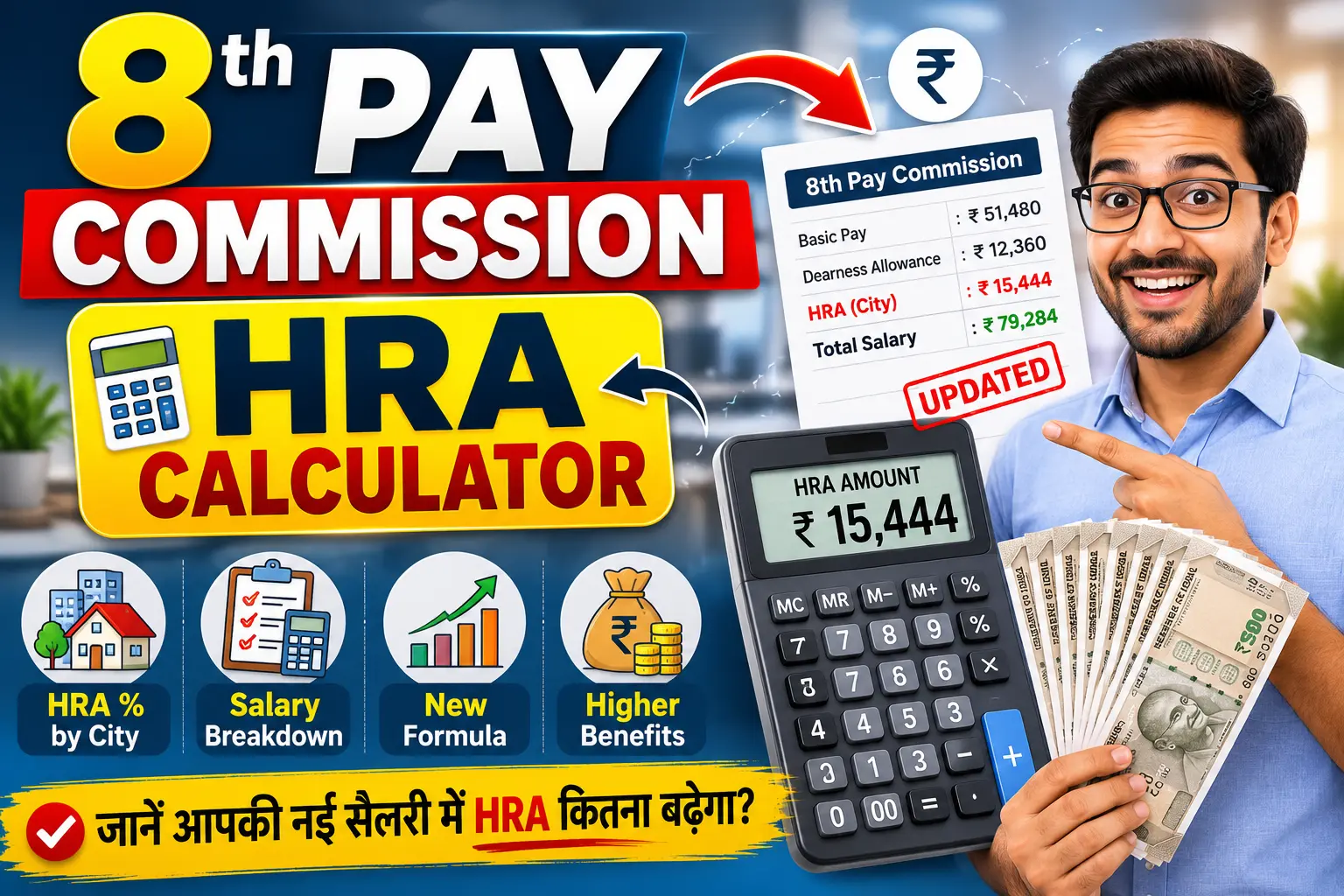
Central government employees searching for an 8th Pay Commission HRA calculator this week are walking into a moment where the process has genuinely moved forward, even if the final numbers are still months away. As of mid-July 2026, the Commission has pushed back a key deadline, the Dearness Allowance has already ticked up separately from the pay revision, and employee bodies have sharpened their demands on fitment factor and allowances. Here’s the latest picture, along with a calculator to help you model what your own HRA and gross pay could look like.
Current HRA
Rs 5,400
Revised basic pay
Rs 46,260
Revised HRA
Rs 13,878
Est. gross (basic + HRA)
Rs 60,138
Illustrative only, based on scenarios discussed as of July 2026. Fitment factor, revised HRA rates and DA are not yet finalised by the government. Gross figure excludes DA, TA and deductions.
What’s New This Week
The most immediate update is procedural but important: the 8th Pay Commission has extended the deadline for ministries, departments, states, and Union Territories to submit workforce data through its Online Data Portal from June 30 to July 31, 2026. The Commission has also been firm that it will only accept submissions through this official portal, explicitly ruling out physical data, standalone Excel sheets, or emails. This data feeds directly into how the Commission eventually calculates the revised pay matrix, so the extension effectively pushes the timeline for a final report slightly further out, with recommendations now expected sometime between February and April 2027, based on the standard 18-month cycle from the Commission’s November 3, 2025 constitution.
Separately from the pay commission process, the government has also approved a routine 2% Dearness Allowance hike effective January 1, 2026, taking DA from 58% to 60% of basic pay. This bump is unrelated to the 8th Pay Commission’s own recommendations and will keep applying under the existing 7th CPC structure until the new pay matrix is actually notified. It’s a detail that any 8th Pay Commission HRA calculator needs to keep separate, since DA and HRA move independently even though both are tied to basic pay.
Where the Fitment Factor Debate Stands
The fitment factor remains the single biggest unresolved variable, and it’s the number every 8th Pay Commission HRA calculator ultimately hinges on. Employee and pensioner organisations met on February 25, 2026 in New Delhi under the National Council’s Joint Consultative Machinery, where a drafting committee led by Shiva Gopal Mishra firmed up a formal charter of demands to submit to the Commission’s chairperson, Justice Ranjana Prakash Desai. Their headline ask is a 3.25 fitment factor, well above the 7th Pay Commission’s 2.57, along with a 7% annual increment rate instead of the current 3%, and an extension of leave encashment at retirement from 300 to 400 days.
If the Commission ultimately lands closer to 2.86 rather than 3.25, the minimum basic pay could still rise from ₹18,000 to roughly ₹51,480, with the minimum pension climbing from ₹9,000 toward ₹25,740. These remain projections built on employee-body proposals and historical patterns rather than confirmed figures, which is exactly why running your own numbers through an 8th Pay Commission HRA calculator across a few different fitment scenarios is more useful than fixating on any single projected number.
HRA: The Part That Moves With Basic Pay
House Rent Allowance is currently paid at 30%, 20%, and 10% of basic pay for X (metro), Y, and Z category cities respectively, rates that took effect once DA crossed the 50% mark in January 2024. Since HRA is purely a percentage of basic pay, any revision to the basic pay structure under the 8th Pay Commission automatically lifts HRA in step, even before the Commission touches the percentage itself. This is the core logic behind every 8th Pay Commission HRA calculator: you’re really running two multiplications, one for the fitment factor against basic pay, and a second for the HRA percentage against that revised basic pay.
Employee federations have gone a step further and asked for the HRA percentages themselves to be raised, arguing that housing costs in large cities have outpaced the current 30/20/10 structure. Whether that demand is accepted will only be known once the Commission’s report is finalised and the Cabinet notifies the changes, likely sometime in 2027 based on how the 7th Pay Commission’s own timeline played out, with arrears calculated back to the January 1, 2026 reference date.
Try the Calculator
Given how many moving parts are still unsettled, the most practical way to use an 8th Pay Commission HRA calculator right now is as a scenario tool rather than a prediction engine. Enter your current basic pay, choose your city category, and slide the fitment factor to see your projected basic pay, HRA, and gross salary update instantly. Since the government hasn’t finalised the fitment factor or the HRA percentages, treat every output as one possible outcome among several, not a locked-in figure.
What to Watch Next
Keep an eye on three dates over the coming months: the July 31 data submission deadline, any further stakeholder consultations the Commission schedules through the rest of 2026, and the eventual submission of the final report, expected in the February–April 2027 window. Until then, an 8th Pay Commission HRA calculator remains the best way to stay prepared for what’s coming, even as the underlying numbers keep evolving. For confirmed details, always cross-check against official government notifications rather than projected estimates.
Read Other Blog Posts: Click Here
- Your August Horoscope 2026: What The Stars Have Planned For Every Zodiac Sign
- सावन के दूसरे सोमवार पर शिवालयों में उमड़ी भक्तों की भीड़, बिल्वपत्र और जल से हुआ अभिषेक
- Sold Out Everywhere: Gopal Madhavan Bhagyoday Becomes India’s Most Wanted Book
- 8th Pay Commission HRA Calculator: Latest Updates and How to Estimate Your Revised Pay
- iPhone 18 Release Date Announced?